
People creation takes more time than destruction ever could, and this became the soul of proverbs like “Rome wasn’t built in a day, but burned in one.”
But when you are a developer, you can relate to the fact that building takes time, but destroying takes effort, and sometimes it could prove to be one of the most difficult things to do.
And in this blog, we are going to discuss on one such destruction, which could be a bit too tricky for beginners, and that is data clearance from a filled form in ODC.
But before we start, let’s first understand what we are going to discuss in this blog.
Now that we have structured the blog, let’s dive into the problem again.
What is OutSystems?
Before we discuss about how to remove all the information from a form, let’s first understand what is OutSystems.
OutSystems is a low-code platform that helps developers to develop applications faster and deploy them faster by leveraging the drag-and-drop features and built-in reusable components, so that the developers don’t have to create the same thing again and again.
While OutSystems is a low-code platform, it offers the flexibility of choosing the type of applications, as it can create responsive web and mobile applications; on the other hand, it can also create traditional applications.
So, in other words, we can say that OutSystems is a platform for developers that facilitates the development process with its features and components, while it is also a boon for organisations, as their applications can be delivered faster than they can imagine.
What is ODC?
ODC, also known as OutSystems Developer Cloud, is a cloud-native low-code platform which give liberty the developer to create cloud based application which can ensure that businesses can get scalable, secure and high-performing applications with the speed of low-code.
In simple words, if we say, then ODC is an advanced version of OutSystems, which not only provides the opportunity to build a faster, high-performing cloud application with the benefits of OutSystems partner, AI mentor and even Agentic AI now, so you can thrive in this fast-paced industry with your own application.
To understand more about ODC and O11, do check out the mentioned blog. Difference Between O11 And ODC
How to Clear Data From a Form in ODC
So now all the basics are discussed, let’s get into the main topic, that is, how can a developer clear data from a form in ODC.
Well, when we talk about ODC and O11, clearing data isn’t very different in any of the versions.
Scenario
So the scenario is simple, there is a form that is created to store the information about students. For better understanding, you can look at the Fig 1.
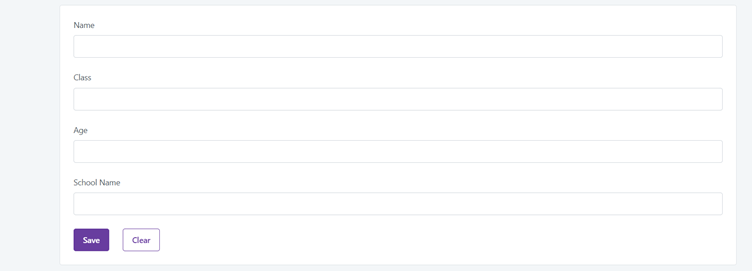
Fig 1
After filling the form, someone realised that the whole data is wrong, so they wanted to clear the form. There are two main approaches to it.
- Clear all the fields manually: Sounds good until the number of fields isn’t just 3-4 but reaches around 40 or 50.
- A button to clear: Well, this is the option we are going to discuss today, with the logic you should implement to achieve the result.
Test Case
The case is as clear as you can think.
Let’s suppose there is a form filled with data, just like in Fig 2, and the user wants to clear the form data.
Fig 2
The user should click on the “Clear”, and the data in the form should be removed.
Logic
If we talk about how to implement it in the backend, then there should be a client action that is triggered by the “Clear” button. Inside, the developer is setting the value of each attribute to null according to their respective data type.
To understand it more clearly, do refer to Fig 3, and after implementing this logic, you can publish the changes, and when you test it, your goal will be achieved.
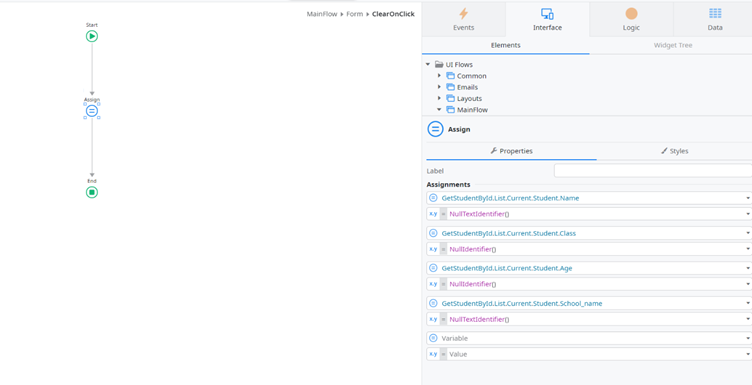
Fig 3
Conclusion
As we have discussed, a very basic but most commonly required scenario, we can conclude through this block that you can have easy solutions for difficult problems, while sometimes in the process of development you will see that there are difficult solutions for easy problems as well, but you don’t have to worry about it, because we will keep coming back with solutions of common but tricky problems.
If you liked this blog or wanted to know about these types of knowledgeable and problem-solving articles, then do subscribe to our newsletter.
Happy Coding !!!

As the Co-founder & CEO and Senior Architect at Stepfinity Software, I have been delivering OutSystems development solutions since 2014. I specialize in architecting scalable, business-driven applications that bridge low-code and high-code development. With expertise in OutSystems, .NET, REST APIs, system architecture, OCR, NLP, web scraping, and enterprise application development, I have successfully delivered complex solutions across healthcare, EV charging, claims management, loan origination, and other industries.