
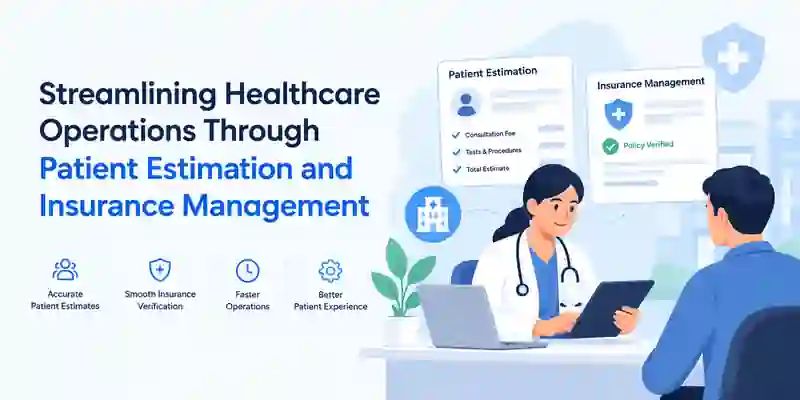
A Healthcare Case Study on Improving Cost Transparency, Insurance Compliance, and Patient Experience
Introduction
Healthcare organizations must coordinate patient care, treatment costs, insurance eligibility, authorization requirements, and referrals. When these processes are managed independently, hospitals may face delayed treatments, unexpected expenses, claim rejections, and administrative inefficiencies.
This case study presents a hypothetical healthcare organization, ABC Healthcare Network, and explores how an integrated healthcare management system can streamline patient estimation, Electronic Patient Records (EPR), insurance authorization (Auth), and referral management.
The objective is to demonstrate how these processes can work together to support informed treatment decisions, improve operational efficiency, and provide greater transparency to patients.
Business Challenge
ABC Healthcare Network operates multiple hospitals and outpatient clinics and serves patients covered by different insurance providers.
The organization faces several operational challenges:
- Unclear treatment costs: Patients may not know their expected expenses before treatment begins.
- Authorization delays: Certain medical services require prior approval from insurance providers.
- Missing referrals: Some insurance plans require referrals before specialist consultations or other services.
- Claim rejections: Missing authorization, invalid referrals, or incorrect insurance information can lead to denied claims.
- Disconnected workflows: Patient records, treatment estimates, and insurance requirements may be managed across different systems.
- Manual verification: Administrative teams spend time checking insurance rules and following up on pending requests.
ABC Healthcare Network wants to introduce an integrated workflow that connects patient encounters, treatment estimation, authorization, and referral validation.
Patient Scenario: From Consultation to Treatment Estimation
Consider a hypothetical patient, John Smith, who visits a hospital with persistent knee pain.
After examining the patient, the doctor recommends a consultation, an X-ray, an MRI scan, and five physiotherapy sessions.
John has health insurance, but the hospital must verify the applicable coverage and determine whether any services require prior authorization or a referral.
Patient Information
- Patient ID: PAT-10025
- Patient name: John Smith
- Reason for visit: Persistent knee pain
- Proposed treatment: Consultation, diagnostic imaging, and physiotherapy
- Insurance provider: ABC Health Insurance
- Encounter status: Initial assessment
Estimated Treatment Cost
| Medical service | Estimated cost |
|---|---|
| Doctor consultation | ₹1,000 |
| Knee X-ray | ₹1,500 |
| MRI scan | ₹8,000 |
| Physiotherapy (5 sessions) | ₹2,500 |
| Total estimated cost | ₹13,000 |
The estimated treatment cost is ₹13,000.
This estimate provides John with an initial understanding of the expected expenses. The final payable amount may differ depending on the services delivered, insurance coverage, contractual rates, deductibles, copayments, and other applicable charges.
Note: The patient, healthcare organization, insurance provider, and costs in this scenario are illustrative.
The Role of EPR in Patient Management
Electronic Patient Records (EPR) provide a structured way to maintain patient and encounter information throughout the care process.
When John visits the hospital, the system creates or retrieves his patient record and records the details of the current encounter.
The encounter may include:
- Patient demographics and identifiers.
- Visit date and treating physician.
- Presenting symptoms and clinical assessment.
- Diagnosis and proposed treatment.
- Requested medical services.
- Associated treatment estimation.
- Relevant insurance and encounter status information.
The proposed services are then used to calculate the estimated cost.
For example, if the doctor removes the MRI from the treatment plan, the system recalculates the estimate:
Original estimate: ₹13,000
MRI cost removed: ₹8,000
Revised estimate: ₹5,000
The revised estimate helps the patient and hospital understand the financial impact of the treatment-plan change.
Business value: EPR connects the patient’s clinical encounter with the services being considered and provides a foundation for accurate estimation and downstream administrative processes.
Insurance Authorization (Auth) Management
Not every medical service requires prior authorization. Requirements depend on the patient’s insurance plan, the type of service, provider arrangements, and other applicable rules.
In this scenario, the hospital’s configured insurance rules indicate that the MRI requires authorization.
The system evaluates each proposed service against the applicable authorization rules.
| Medical service | Estimated cost | Example authorization requirement |
|---|---|---|
| Doctor consultation | ₹1,000 | Not required |
| Knee X-ray | ₹1,500 | Not required |
| MRI scan | ₹8,000 | Required |
| Physiotherapy | ₹2,500 | Depends on the insurance plan |
The system identifies the MRI as requiring authorization and creates or flags an authorization request for the administrative team.
The team submits the required clinical and insurance information to the payer and tracks the response.
Possible authorization statuses include:
- Pending
- Approved
- Denied
- Additional information required
If authorization is denied, the affected service is flagged for review. The care team follows the applicable clinical and payer processes before deciding how to proceed.
An authorization approval should not be treated as a guarantee of payment because final claim adjudication may depend on additional coverage and billing conditions.
Business value: Automated authorization checks help identify services requiring approval, improve visibility into pending requests, and reduce avoidable claim issues caused by missing authorization.
Referral Management
Referral requirements determine whether a patient must be referred by an eligible provider before receiving particular services.
Suppose John’s insurance plan requires a valid referral from his primary care physician before a specialist consultation.
The system checks the configured referral rule and evaluates the available referral information.
Three scenarios are possible.
Scenario A: Valid referral exists
The system confirms that the required referral information is available and valid under the configured rules. The specialist consultation can proceed according to the applicable plan requirements.
Scenario B: Referral is missing
The system identifies the missing referral and flags the case for administrative follow-up. The responsible team arranges the required referral before proceeding where the plan requires it.
Scenario C: Referral is not required
The system identifies that the applicable plan does not require a referral for the service, so no referral-related restriction is applied.
Referral validation may consider the referring provider, referral date, validity period, specialist or service type, and other plan-specific conditions.
Business value: Referral validation helps reduce administrative delays, improve compliance with payer requirements, and prevent avoidable claim rejections associated with missing or invalid referrals.
End-to-End Integrated Workflow
The proposed solution connects the processes into a single workflow.
Step 1: Patient Registration
The hospital retrieves or creates the patient’s record and captures the relevant insurance information.
Step 2: Patient Encounter Creation
The doctor records the visit, clinical assessment, diagnosis, and proposed services in the EPR.
Step 3: Treatment Estimation
The system calculates the estimated cost using configured service prices, quantities, and applicable adjustments.
Step 4: Insurance Rule Evaluation
The system checks the applicable insurance rules to identify authorization and referral requirements.
Step 5: Authorization and Referral Processing
The administrative team submits authorization requests and resolves missing referral information where required.
Step 6: Treatment Coordination
The hospital coordinates treatment based on clinical decisions, required approvals, referral conditions, and applicable policies.
Step 7: Billing and Claim Submission
After services are delivered, the hospital prepares billing and submits claims according to the applicable payer requirements.
Step 8: Reconciliation and Reporting
The organization compares estimates with actual charges, tracks authorization outcomes, and analyzes claim rejections and operational delays.
Proposed System Architecture
The solution can be organized into the following functional modules:
- Patient Management: Maintains patient identifiers, demographics, and relevant administrative information.
- Encounter Management: Stores visit details, diagnosis, proposed services, and encounter status.
- Estimation Engine: Calculates service-level and total estimated costs.
- Insurance Rule Engine: Evaluates configured authorization and referral requirements.
- Authorization Management: Tracks requests, payer responses, and approval status.
- Referral Management: Validates referral details and identifies missing or invalid information.
- Billing and Claims: Supports billing preparation and claim-processing workflows.
- Reporting and Audit: Tracks estimate revisions, rule decisions, status changes, and operational metrics.
These modules should share consistent patient, encounter, service, and insurance identifiers so that changes can be traced throughout the workflow.
Key Business Benefits
An integrated solution can deliver several potential benefits.
Improved cost transparency: Patients receive an estimate before treatment, helping them understand expected expenses.
Reduced administrative effort: Automated rule evaluation reduces repetitive manual checks.
Better authorization visibility: Teams can identify services awaiting approval and prioritize follow-up.
Fewer preventable claim issues: Early identification of missing authorization or referral information can reduce avoidable rejections.
Improved data consistency: Shared encounter and estimation records reduce duplication and discrepancies between systems.
Stronger auditability: Original estimates, revised estimates, authorization decisions, and referral validations can be recorded for later review.
Better operational reporting: Management can track estimate accuracy, pending approvals, referral exceptions, and claim outcomes.
These are expected benefits of the proposed solution, not measured results from a deployed healthcare organization.
Suggested Performance Indicators
To evaluate the solution after implementation, ABC Healthcare Network could monitor:
- Percentage of encounters with an estimate created before treatment.
- Average time required to generate a treatment estimate.
- Percentage of authorization requests submitted before the relevant service.
- Average authorization turnaround time.
- Number of encounters flagged for missing referrals.
- Claim rejection rate attributable to authorization or referral issues.
- Difference between estimated and actual treatment costs.
- Average time from encounter creation to treatment readiness.
Establishing a baseline before implementation would allow the organization to measure actual improvements rather than relying on assumptions.
Conclusion
Patient estimation, EPR, authorisation, and referral management are interconnected components of healthcare operations.
Patient estimation provides visibility into expected costs. EPR connects the estimate with the patient’s encounter and proposed treatment. Authorization management identifies services that require payer approval, while referral management validates referral-related conditions.
By integrating these capabilities, healthcare organizations can establish a more consistent workflow from the initial patient visit through treatment coordination, billing, and claim submission.
The broader objective is to improve cost transparency, reduce avoidable administrative issues, and support a more coordinated healthcare experience for patients, providers, and insurance teams.
Final takeaway: Effective healthcare management is not just about calculating treatment costs. It is about connecting clinical encounters, financial estimates, and insurance requirements in a structured, traceable workflow.