
A Real-World Enterprise Case Study from a Tech Lead Perspective
Disclaimer: The workflows, orchestration logic, and implementation screenshots used in this case study are simplified and created for demonstration purposes. Production implementations may vary depending on enterprise architecture, security standards, scalability requirements, and business constraints.
Introduction
Enterprise applications today process massive amounts of unstructured information including support tickets, operational incidents, emails, approval requests, and business queries. Most systems still depend heavily on predefined business rules and static workflows to process this information.
Traditional automation works effectively only when user input remains predictable. However, enterprise systems rarely operate under predictable conditions. Users describe problems differently, context changes dynamically, and edge cases increase rapidly as systems scale.
I encountered this challenge while designing a ticket triage workflow in OutSystems Developer Cloud (ODC). The existing process relied heavily on manual classification and static rules. As the ticket volume increased, response accuracy reduced and operational overhead increased significantly.
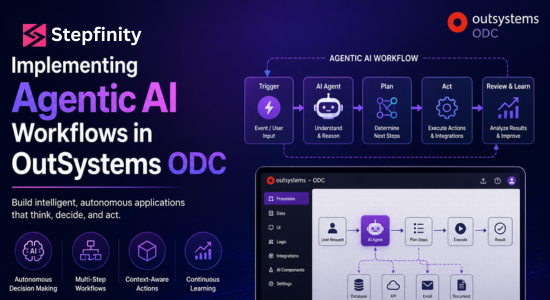
Instead of extending static rules further, I implemented an Agentic AI workflow capable of understanding intent, retrieving enterprise context, orchestrating decisions dynamically, managing memory, and generating grounded responses using Gemini AI.
Understanding Agentic AI in Enterprise Systems
Most AI implementations today still behave like prompt-response systems. A user sends input to an LLM, and the model generates an output. While this approach works for simple chatbot scenarios, enterprise systems require far more control and contextual intelligence.
Enterprise AI systems must handle reliability, governance, contextual awareness, response validation, and continuity. Pure LLM-based systems fail because they often generate hallucinated responses, lose context, and operate without enterprise grounding.
Agentic AI changes this architecture completely. Instead of directly generating responses, the system behaves like a decision-making workflow capable of understanding objectives, orchestrating actions, retrieving data dynamically, validating context, and managing conversational continuity.
Instead of operating as:
Input → Output
The Agentic workflow behaves like:
Understand → Analyze → Retrieve → Validate → Decide → Respond
Why OutSystems ODC Fits Agentic AI Workflows
OutSystems Developer Cloud (ODC) provides a service-oriented, cloud-native architecture that aligns strongly with intelligent enterprise systems.
Reactive applications in OutSystems 11 support modular development and API exposure, but deployments remain relatively coupled. ODC introduces a significantly more scalable architecture through independently manageable services and API-first design.
This architecture becomes extremely valuable when implementing AI systems because AI workloads require orchestration, external integrations, memory handling, asynchronous processing, and independent scaling.
In this implementation, ODC allowed me to separate the system into independently manageable services:
- Grounding data retrieval service
- Message orchestration service
- Gemini AI integration service
- Memory handling service
- Response processing service
The Real Enterprise Problem
The original ticket handling workflow depended heavily on manual categorization and static keyword matching. Users described the same issue in different ways, making rule-based filtering unreliable.
For example, a user might write:
“Invoice upload crashes after validation completes.”
A static workflow struggled because:
- Keywords varied significantly
- Intent changed dynamically
- Context differed between users
- Business rules became increasingly complex
The real problem was not automation. The real problem was lack of contextual intelligence.
High-Level Agentic AI Workflow
User Input → Get Grounding Data → Build Messages → Gemini Processing → Store Memory → Final Response
This workflow does not simply call an LLM API. The orchestration layer controls how enterprise context, prompts, grounding data, and memory are injected into the AI system.
Main Agentic Workflow in ODC
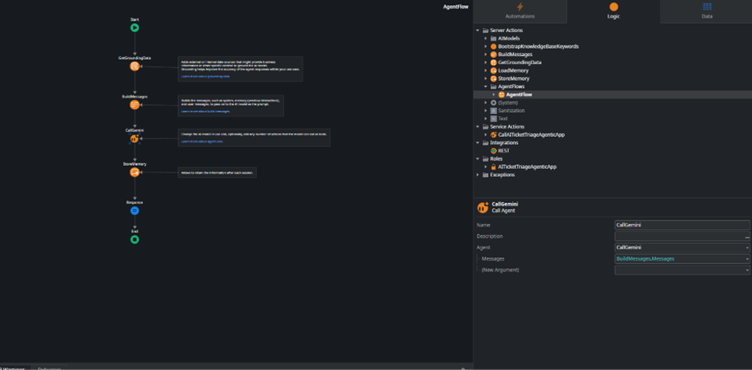
Figure 1 — Main Agentic AI Workflow
The primary Agent Flow acts as the orchestration layer of the entire AI system. The workflow retrieves grounding data, builds contextual messages, processes requests through Gemini AI, stores conversational memory, and finally generates the response.
This orchestration layer is the core intelligence engine of the system. The AI model alone does not provide intelligence. Intelligence emerges from how the workflow controls context, execution flow, memory, validation, and enterprise grounding.
Grounding Layer — Why Enterprise AI Needs Context
One of the biggest failures in enterprise AI systems comes from lack of grounding. Pure LLM systems generate responses without enterprise context, which increases hallucination risk and reduces reliability.
To solve this problem, I implemented a grounding layer responsible for retrieving contextual enterprise data before sending requests to Gemini AI.
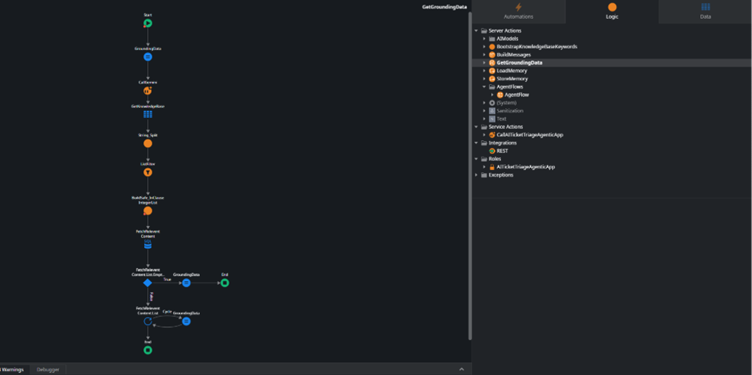
Figure 2 — Grounding Data Retrieval Workflow
The workflow sanitizes user intent, filters keywords, retrieves relevant knowledge base identifiers, constructs safe SQL filters, and fetches the most relevant contextual content.
Knowledge grounding significantly improves:
- Response accuracy
- Enterprise reliability
- Contextual understanding
- Hallucination prevention
- Decision quality
SQL-Based Context Retrieval
The grounding workflow uses SQL to dynamically retrieve contextual enterprise content from the knowledge base.
SELECT {KnowledgeBase}.[Content]
FROM {KnowledgeBase}
WHERE {KnowledgeBase}.[Id] IN (
SELECT CAST(value AS INTEGER)
FROM unnest(string_to_array(@KnowledgeBaseIds, ‘,’)) AS value
)
LIMIT 3
This query ensures that Gemini AI receives only the most relevant contextual information instead of unrestricted enterprise data.
Message Construction Layer
Prompt orchestration became one of the most critical components of the implementation. Uncontrolled prompts frequently generate inconsistent or unsupported responses.
Figure 3 — Dynamic Message Construction Workflow
The Build Messages workflow dynamically constructs the conversational payload sent to Gemini AI. The orchestration layer combines multiple components before execution.
- System prompts
- Grounding context
- Memory data
- Previous interactions
- User messages
- Execution constraints
This approach creates a controlled conversational environment where Gemini AI operates within enterprise-defined boundaries instead of generating unrestricted outputs.
Memory Handling Layer
Enterprise conversations rarely exist as isolated interactions. Users continue conversations, reference previous issues, and expect contextual continuity.
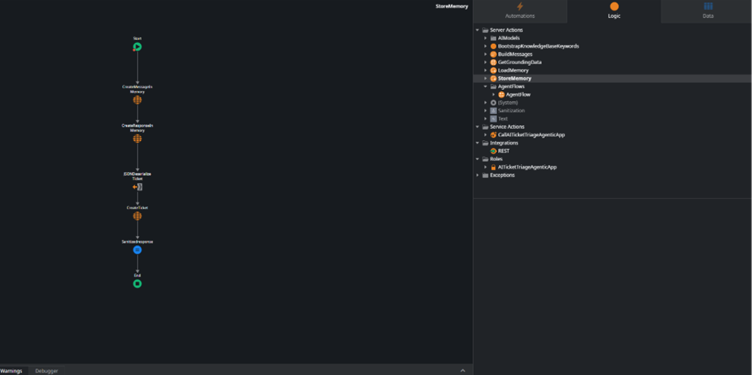
Figure 4 — Memory Storage Workflow
The memory layer stores prompts, generated responses, and contextual references to maintain continuity across multiple interactions.
This improves:
- Conversational continuity
- Context retention
- User experience
- Multi-step interaction handling
- Semantic consistency
Why This System is Truly Agentic
- The workflow analyzes intent before execution.
- The system retrieves contextual enterprise data dynamically.
- The orchestration layer controls execution flow.
- Grounding validates AI responses before generation.
- Memory handling maintains continuity across interactions.
- The workflow makes decisions dynamically instead of relying on static rules.
This implementation does not behave like a traditional chatbot. It behaves like an orchestrated enterprise decision engine.
Tech Lead Perspective — Key Engineering Decisions
The most important architectural decision was avoiding direct dependency on the LLM. Enterprise AI systems require orchestration, governance, validation, and contextual grounding.
I intentionally separated the application into modular services handling grounding retrieval, message orchestration, AI processing, memory persistence, and response generation.
This architecture aligns strongly with ODC’s service-oriented design philosophy and improves maintainability, scalability, and extensibility.
Challenges During Implementation
Hallucinated Responses: Solved using strict grounding and controlled prompts.
Weak Semantic Matching: Improved using sanitization and better keyword extraction.
Performance Bottlenecks: Optimized using reduced payload sizes and efficient SQL retrieval.
Context Loss: Solved using conversational memory persistence.
Prompt Inconsistency: Improved using structured message orchestration.
Performance Optimization Strategy
AI-driven systems require significantly more optimization than traditional workflows because LLM calls introduce latency and higher computational overhead.
I optimized the workflow using asynchronous processing, efficient query filtering, response caching, payload minimization, and service-level separation.
Security and Governance
Enterprise AI introduces new governance and security challenges. The implementation included strict prompt boundaries, API authentication, role-based access control, and enterprise data protection.
Sensitive information was never directly exposed to Gemini AI without validation and contextual filtering.
Future of Agentic AI in OutSystems
Agentic AI will fundamentally change enterprise application architecture. Systems will evolve from static workflows into intelligent orchestration engines capable of contextual decision-making.
Future enterprise systems will dynamically orchestrate actions, maintain long-term memory, self-optimize workflows, and automate intelligent decisions using contextual awareness.
Conclusion
This implementation started as a ticket triage solution but evolved into a fully orchestrated Agentic AI workflow built using OutSystems ODC.
The most important lesson from this implementation was that enterprise AI requires far more than LLM integration. Enterprise AI requires orchestration, grounding, validation, memory management, and architectural discipline.
The intelligence of the system does not come only from Gemini AI. The real intelligence comes from how the workflow controls context, retrieves enterprise data, validates responses, and orchestrates execution.
With the right architecture, OutSystems ODC becomes far more than a low-code platform. It becomes a foundation for building intelligent enterprise systems at scale.