
The demand for faster and more efficient software development solutions is higher than ever. Low-code development platforms have emerged as a game-changer, enabling both technical and non-technical users to build applications quickly and with minimal coding. In this comprehensive guide, we will explore the top low-code development platforms of 2026-2027, their features, benefits, and how they can transform your application development process.
What Are Low-Code Development Platforms?
Low-code development platforms are software environments that provide visual development tools to create applications with minimal hand-coding. They offer drag-and-drop interfaces, pre-built templates, and integration capabilities, making application development accessible to a wider range of users, including those with limited coding experience.
Benefits of Low-Code Development Platforms
- Speed: Accelerate application development and deployment.
- Cost-Efficiency: Reduce the need for extensive coding and specialized skills, lowering development costs.
- Flexibility: Easily adapt to changing business requirements.
- Collaboration: Enhance collaboration between IT and business teams.
- Scalability: Develop scalable solutions that grow with your business needs.
Top Low-Code Development Platforms of 2026-2027
1. Mendix
Mendix is a leading low-code platform known for its comprehensive and robust features. It supports both web and mobile application development and offers extensive integration capabilities.
- Key Features: Visual development tools, AI-assisted development, multi-cloud deployment.
- Best For: Large enterprises looking for scalable solutions.
- Pricing: Free tier available; enterprise plans start at $1,875/month.
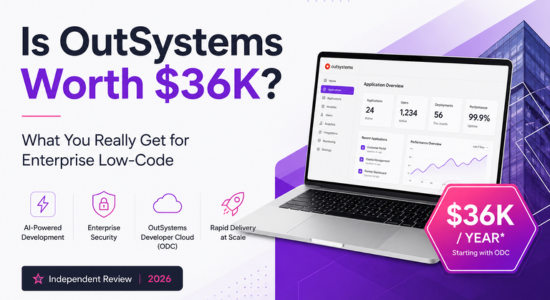
2. OutSystems
OutSystems is a powerful low-code platform designed for enterprise-grade applications. It offers full-stack development capabilities and real-time performance monitoring.
- Key Features: Drag-and-drop interface, full-stack development, real-time monitoring.
- Best For: Enterprises needing advanced integration and scalability.
- Pricing: Starts at $4,000/month for enterprise solutions.
3. Appian
Appian combines low-code development with process automation, making it ideal for businesses looking to streamline complex workflows and improve operational efficiency.
- Key Features: Process automation, case management, AI integration.
- Best For: Businesses focused on automating workflows and improving efficiency.
- Pricing: Pricing available on request.
4. Microsoft Power Apps
Part of the Microsoft Power Platform, Power Apps offers a user-friendly interface and seamless integration with other Microsoft products like Office 365 and Azure.
- Key Features: Pre-built templates, easy integration with Microsoft ecosystem, AI Builder.
- Best For: Organizations already using Microsoft products.
- Pricing: Starts at $10/user/month.
5. Zoho Creator
Zoho Creator is an affordable low-code platform perfect for small to medium-sized businesses. It offers a variety of customization options and supports mobile app development.
- Key Features: Customizable templates, mobile app builder, integration with Zoho suite.
- Best For: Small to medium-sized businesses.
- Pricing: Starts at $25/user/month.
How to Choose the Right Low-Code Development Platform
When selecting a low-code platform, consider the following factors:
- Business Needs: Identify the specific requirements of your business and choose a platform that aligns with those needs.
- Ease of Use: Ensure the platform is user-friendly, especially if non-developers will be using it.
- Integration: Check for integration capabilities with your existing systems and tools.
- Scalability: Choose a platform that can grow with your business.
- Support and Community: Look for platforms with strong support and active user communities.
Future Trends in Low-Code Development Platforms
- AI and Machine Learning Integration: Increasingly, low-code platforms are incorporating AI and machine learning capabilities to automate more complex tasks and provide predictive analytics.
- Increased Adoption of Multi-Experience Development: Platforms will support a broader range of application types, including web, mobile, and chatbots, all from a single low-code environment.
- Enhanced Security Features: As more businesses adopt low-code, platforms will continue to enhance security features to protect sensitive data and ensure compliance with regulations.
- Expansion of Ecosystem and Integrations: Low-code platforms will expand their ecosystems, offering more integrations with third-party services and APIs to provide even greater flexibility.
- Greater Focus on User Experience: Future developments will focus on improving the user experience, making it even easier for non-technical users to build and deploy applications.
Conclusion
Low-code development platforms are transforming the way businesses create applications, offering speed, flexibility, and cost-efficiency. By leveraging the best platforms and staying ahead of emerging trends, businesses can harness the full potential of low-code to innovate and thrive in 2026-2027. Whether you’re a small business or a large enterprise, low-code development platforms can help you stay competitive in today’s fast-paced digital environment.

I’m a 4x Certified OutSystems Developer specializing in Agentic AI, Tech Lead, Associate Developer, and ODC, with 3 years of experience in low-code application development. I have strong expertise in handling complex projects, leading development efforts, and making technical decisions to deliver scalable and efficient solutions.